If we look at companies around the world, we find that organizational culture extremely important to a company’s success. Let’s take Toyota as an example. Since its founding in 1937, Toyota Motor Corporation has grown into the world’s largest manufacturer and seller of automobiles. Much of the company’s success has been credited to the company’s organizational culture, which focuses on the employees’ responses to challenges that the organization faces in the highly competitive market. In this case, Toyota views its organizational culture management as a critical practice that maximizes the innovative capabilities of the human resource. At the same time, Taherimashhadi and Ribas (2018) note that the company has also benefited significantly from its organizational culture because of its immense support in the company’s problem solving. Hence, the various features of the organizational culture, including their shared beliefs, shared values, norms, as well as the individual and group mentalities are focused on overcoming the competition and other market-related challenges that the company faces.

Despite the immense financial and business success that the company has achieved through its market-oriented organizational culture, the recent developments in the market and the society in general in terms of societal expectations, competitive innovation, and ethical challenges puts pressure on the company to consider c change in the organizational culture. In particular, the modern society is becoming increasingly conscious of the environment, global warming, and the need for sustainability and eco-friendly human practices (Crutchfield & Roughton, 2013). Consequently, Toyota is compelled to respond to the new market dynamics by establishing an environment-friendly organizational culture to attract, retain, and satisfy the needs and expectations of the target customers and the society at large.

Challenges Faced by Toyota
Among the major problems faced by Toyota is the recall crisis, which has led to the fluctuations in the company’s sales volumes and revenues. Since its formation, the company has continually prioritized building quality automobiles. According to Babeĺová and Vaňová (2014), the Japanese Kaizen concept, which emphasizes on continuous improvement for the manufacture and distribution of reputable, affordable, and quality vehicles. However, the concept has not kept up with the customer demands, which has led to significant financial losses for the company. For instance, the larger proportion of the recalled vehicles and the emotionally-charged accidents were attributed to the vehicles’ sudden acceleration, which are attributed to poor combustion systems. In addition, the vehicles have also been faulted for excessive emissions, which contravene the customers’ desire for an emission-free environment (Winkler, U’ren, & Abraham, 2018). Although vehicle recalls are not uncommon, especially in the United States where stringent laws have been operationalized to guarantee safety for motorists and the environment, the recalls reported by Toyota are worrying, especially for a company that prides itself in prioritizing quality of the vehicles and customer satisfaction.
Besides, Toyota is faced by an intense competition other automobile producer who have invested significantly in meeting the society’s expectations and desires for environmentally-friendly vehicles. For instance, Honda provides a stiff competition in the manufacture of Hybrid vehicles that exhibit both environmental and innovation competiveness, which threatens Toyota’s survival and profitability in the lucrative automobile industry.
Implementation Strategy
The implementation of the environmentally-friendly corporate culture should begin with the understanding that cultural change is a routine form of organizational evolution, rather than a revolution. Hence the first step would involve nurturing motivation and commitment to the proposed change among the stakeholders. According to Babeĺová and Vaňová (2014), the employees constitute the most valuable group in culture change because they are the ones with the ability of implementing the desired environmental practices through their daily work. Hence, the motivation and commitment of the employees becomes the priority for Toyota management as a way of fostering willingness to alter their working schedules and patterns.
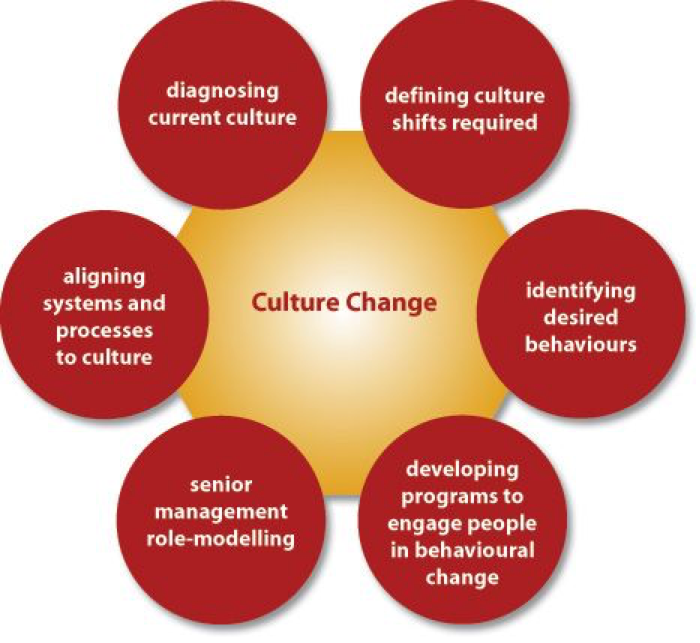
The next step in the culture change should involve communicating the envisioned change to the organization. Winkler, U’ren, and Abraham (2018) emphasize on the significance of communication as a method by which companies can keep their employees constantly committed when initiating cultural and organizational changes. Ultimately, the sufficiently aware employees are more likely to ensure and participate in a voluntary transition to becoming a more environmentally-friendly community, which is more valuable, considering the need for employees to understand the reason for change and the benefits or problems that their new practices are expected to solve.
The management would also be expected to communicate the organizational goals and vision to the employees. Managers are tasked with creating new organizational visions. After stipulating the goals and objectives, the change leaders should lay down the policies for cultural change, which include the codes of conduct and rules that stipulate the core ideals of the organization. In many cases, policies foster organizational commitment. In the end, the implementation process should be gradual but steady for easy execution. The tasks should be broken down into numerous pieces with short-term visible goals to motivate the employees and ensure success for the company.
Conclusion
Toyota Motor Corporation should use a more democratic approach of leadership in the implementation of the corporate culture change to create a learning environment where employees have the right material and morale support, which will encourage them to embrace and execute the environmentally-friendly manufacturing practices.
So, What are your thoughts? Can Culture be managed within Organisations?
References
Babeĺová, Z. G., & Vaňová, J. (2014). Crucial Role of Corporate Culture to Align Organizational Goals with Economic Success. Electronic Journal of Knowledge Management, 12(4), 241–250.
Crutchfield, N., & Roughton, J. E. (2013). Safety Culture : An Innovative Leadership Approach. Oxford: Butterworth-Heinemann.
Taherimashhadi, M., & Ribas, I. (2018). A Model to align the organizational culture to Lean. Journal of Industrial Engineering and Management, 11(2), 207-221.
Winkler, M., U’ren, B., & Abraham, D. (2018). Innovate or die: Insights on entrepreneurial leadership. Governance Directions, 70(11), 723–728.
 Salim's Business World